AOSection 10

Assembling Objects

Spatial reasoning: fit shapes together and track them through rotations.

15 items18 minutes~72 sec / item60 free questions
What the section measures

Assembling Objects measures spatial relationships: whether you can visualise how separate pieces fit into a whole, how a figure looks after it is rotated or reflected, and how lines connect points without crossing. Every item is a figure - a set of pieces to assemble, or a diagram of shapes to match by their relationships - and there is no arithmetic at all.

The two item families are figure assembly, where you choose which arrangement can be built from the given pieces, and figure relationships, where you match a description of connected parts to the correct drawing. Both reward a systematic method; neither rewards speed at the expense of checking.

AO is not part of the AFQT, but it is a strong predictor of success in fields that involve assembly and drawing interpretation, so it appears in several technical line scores. Note also that AO exists only in the computer-administered format - the paper test does not include it - which is why it sits at the end of the section order.

At a glance

Items
15
Minutes
18
Per item
72s

Section 10 of 10 in our timed mock template. This subtest is not part of the AFQT; it feeds service component and line scores used for job qualification.

Topics in this section

  • Connection Puzzles - 20 free questions
  • Rotation & Reflection - 20 free questions
  • Shape Assembly - 20 free questions
Item types

What you will actually see

The shapes below are what our bank is written against, and what the section is built around. None of them are reproduced from the official test.

  • Figure assembly: pick the arrangement that the given pieces can form, with pieces matching in size and shape but usually rotated.
  • Figure matching: identify which complex figure contains the target shape, or which two pieces combine into it.
  • Connections: match a set of rules about which points connect to the drawing that obeys them.
  • Rotation and reflection: choose the view of a figure after it is turned, or its mirror image.
  • Three-dimensional relationships: how a solid looks from another side, or how folded or cut pieces relate.
Topic by topic

How to work each topic

Specific, not generic: what the items in this topic test, and the one or two moves that solve most of them.

Connection Puzzles

Read the connection rules into the diagram one at a time and eliminate drawings that violate a rule immediately - do not try to hold four rules in your head. Check the ends of every line: a description that says a point connects to two others rules out any drawing where it has only one line. Most errors on these items are careless counting, not poor spatial ability.

20 original questions in this topic set.
Rotation & Reflection

Pick a single landmark - the longest edge, the filled corner, the arrow - and follow only that feature through the turn. Decide first whether the option is a rotation or a reflection: a reflected figure reverses the clockwise order of its features, and if the order flipped, it is wrong no matter how similar it looks. Tracking one point beats imagining the whole shape.

20 original questions in this topic set.
Shape Assembly

Total area is conserved, so any option whose outline is visibly larger or smaller than the sum of the pieces can be dropped without mental rotation. Then match edges by length: the longest straight edge of a triangle has to meet an equal-length edge, and notches and tabs have to pair up. Work from the most distinctive piece - usually the largest or most irregular - rather than from the answer choices.

20 original questions in this topic set.
Worked examples

Original questions, answered

Sampled from the Assembling Objects bank below, spread across its topics so you can see the range. The correct option is marked, the method is written out, and the tempting wrong options are explained - the same format you get in the app the moment you answer.

Example 1Connection PuzzlesAssembling Objects · difficulty 2/5
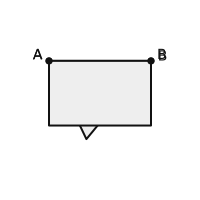
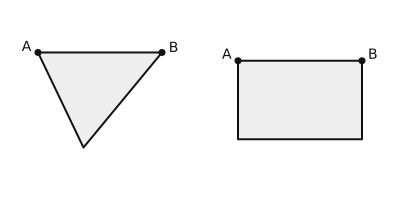
A triangle and a rectangle, each with connection points labeled A and B

The two pieces have labeled connection points. In the correct assembly, point A on the first piece touches point A on the second piece, and point B touches point B, with no overlap. Which option shows the correct connection?

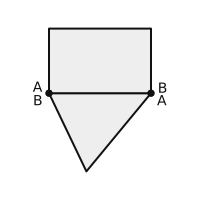
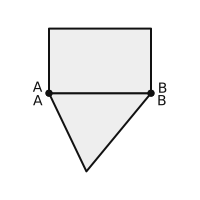
  1. AOption AOption A: the triangle and rectangle joined in a candidate configuration
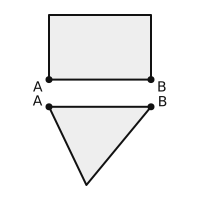
  2. BOption BOption B: the triangle and rectangle joined in a candidate configuration
  3. COption COption C: the triangle and rectangle joined in a candidate configuration
  4. DOption DOption D: the triangle and rectangle joined in a candidate configuration
Answer A

Option A joins the triangle and the rectangle along their shared labeled edge: A meets A and B meets B, and the two pieces lie on opposite sides of that edge, so they touch without overlapping.

Why the other choices are wrong
  • B Option B - The pieces do not actually meet: there is a gap between the connection points, so A is not joined to A and B is not joined to B.
  • C Option C - The pieces are placed on the same side of the connection line, so their interiors overlap. Physical pieces cannot occupy the same space.
  • D Option D - The labels are crossed: A on one piece meets B on the other instead of matching A-to-A and B-to-B.
Example 2Rotation & ReflectionAssembling Objects · difficulty 2/5
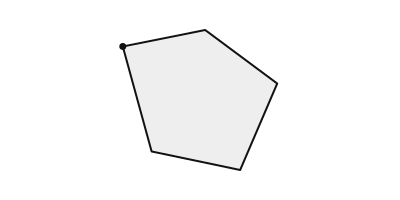
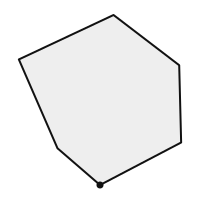
An asymmetric polygon with a marked corner

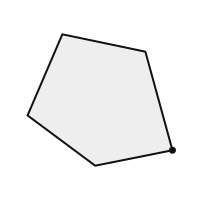
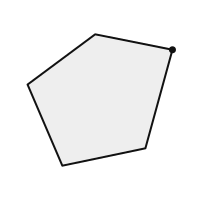
The shape in the diagram is an asymmetric polygon. Which option shows the SAME shape rotated (turned, but NOT flipped over)?

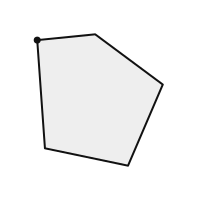
  1. AOption AOption A: a polygon that may be a rotation of the original shape
  2. BOption BOption B: a polygon that may be a rotation of the original shape
  3. COption COption C: a polygon that may be a rotation of the original shape
  4. DOption DOption D: a polygon that may be a rotation of the original shape
Answer C

Option C is the original polygon turned 180 degrees counterclockwise. Every vertex keeps its position relative to the others, so it is the same shape in a new orientation — a rotation, not a flip. The marked corner helps confirm the turn.

Why the other choices are wrong
  • A Option A - One corner of the shape has been moved, so the outline is distorted and no longer matches the original.
  • B Option B - This is a different polygon, not the original shape in any orientation.
  • D Option D - This is a mirror image (flipped) of the original shape. No rotation in the plane can turn a shape into its mirror image.
Example 3Shape AssemblyAssembling Objects · difficulty 2/5
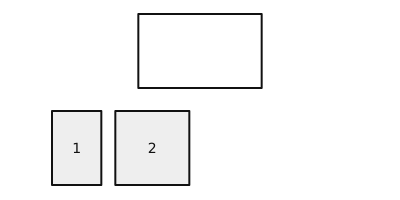
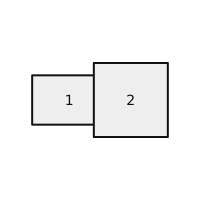
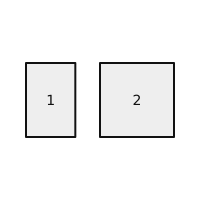
An outline cut into 2 numbered pieces, shown separated and turned for display

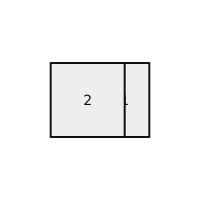
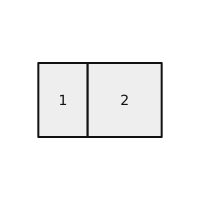
The diagram shows an outline and the pieces it was cut into (pieces are shown turned for display). Which option reassembles ALL the pieces to form EXACTLY the original outline, with no gaps and no overlaps?

  1. AOption AOption A: a candidate assembly of pieces 1, 2
  2. BOption BOption B: a candidate assembly of pieces 1, 2
  3. COption COption C: a candidate assembly of pieces 1, 2
  4. DOption DOption D: a candidate assembly of pieces 1, 2
Answer C

Option C places every piece back in its original position: the piece areas add up to the area of the outline, the pieces share only their cut edges (no overlaps), and together they fill the outline exactly with no gaps.

Why the other choices are wrong
  • A Option A - One piece has been given a quarter-turn, so its width and height no longer match the space it must fill. The outline cannot be completed without gaps or overlaps.
  • B Option B - Two pieces have been put in each other's positions. The result leaves gaps or sticks out past the outline, so it does not match the original shape.
  • D Option D - One piece has been slid sideways out of its proper position, leaving a gap where it belongs and extending past the outline.
Example 4Connection PuzzlesAssembling Objects · difficulty 2/5
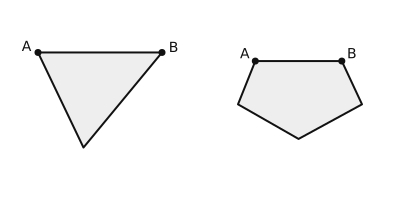
A triangle and a pentagon, each with connection points labeled A and B

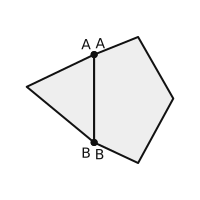
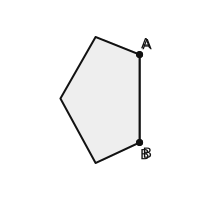
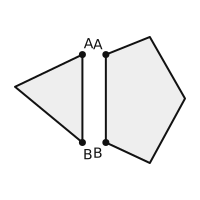
Join the two pieces so that the A dots meet each other and the B dots meet each other, without the pieces overlapping. Which option does this?

  1. AOption AOption A: the triangle and pentagon joined in a candidate configuration
  2. BOption BOption B: the triangle and pentagon joined in a candidate configuration
  3. COption COption C: the triangle and pentagon joined in a candidate configuration
  4. DOption DOption D: the triangle and pentagon joined in a candidate configuration
Answer A

Option A joins the triangle and the pentagon along their shared labeled edge: A meets A and B meets B, and the two pieces lie on opposite sides of that edge, so they touch without overlapping.

Why the other choices are wrong
  • B Option B - The pieces are placed on the same side of the connection line, so their interiors overlap. Physical pieces cannot occupy the same space.
  • C Option C - The pieces do not actually meet: there is a gap between the connection points, so A is not joined to A and B is not joined to B.
  • D Option D - The labels are crossed: A on one piece meets B on the other instead of matching A-to-A and B-to-B.
Strategy

How to study Assembling Objects

  • Use your hands and the answer sheet. Physically rotating the page, or holding two printed pieces up to the screen, converts a mental-rotation problem into a perceptual one, which is far easier.
  • Eliminate by area first. It takes two seconds and typically removes one or two choices before you start visualising.
  • Name features as you work - "the notch on the left end" - because a verbal label is easier to track through a rotation than an image alone.
  • Do the items in order. Skipping a hard AO item and returning later rarely helps, since the difficulty is visual, not analytical.
  • Train with real puzzles: tangrams, flat-pack instructions and shape-sorting games improve this section measurably in a way that drilling does not.
Point loss

Mistakes that cost the most

  • Accepting a mirror image as a rotation - the single most common AO error.
  • Choosing an assembly that looks right but leaves a gap or overlaps two pieces.
  • Ignoring scale: a choice with the correct shape but pieces slightly larger than those given.
  • Trying to evaluate all four figures mentally instead of eliminating the obvious violations first.
  • Spending four minutes on one item; AO is paced at a minute an item and there are sixteen of them.

On the clock

AO is 16 items in 16 minutes on our template - a minute each, which is tight for spatial work. The practical target is 30 seconds per item on the ones you see immediately and saving the rest for the two or three hardest arrangements.

Assembling Objects items are built around figures, so the full AO experience - with the drawings - is in the app. The text-based previews below teach the methods: landmark tracking, elimination by area, and the reflection check.

Free Assembling Objects practice on this site, graded instantly with explanations. Timed sections, wrong-answer review and the full library are in the app.

Download on theApp StoreAndroidComing soon